
Adam garden

Adam is an actor, violence coordinator & instructor for the Action Acting Academy.
His passion is to design and perform fights for stage and screen that are exciting, realistic, and fun for both people who may never pick up a sword, and those who love to.
workshops at AWMAC
Stage Combat Basics
The first part of the class will cover how techniques are adapted to keep fighters safe while performing at full pace with (usually) little to no safety equipment.
Then the second part of the class we’ll put together some short choreography for everyone to perform.
Life, Death, and Injury in the context of Historical Fencing
Looking at historical precedents, through the lens of situational bouting, how do circumstances change the way in which you fight?
Together, we will look at the historical record and explore some of these situations and the debrief on how they affected our fencing.
Cornelius Weber

Cornelius have been mucking around with swords and amour for over over thirty years in a number of styles and traditions.
Founding the Canberra School of Arms and Armour in 2017, he now works in the early German tradition with a particular focus on fighting in armour.
workshops at AWMAC
Pollaxe and Harness
An introduction to the use of the pollaxe and fighting in armour (Harnischfecten).
This class will be a introduction to the pollaxe as described in “Le Jeu de la Hache” as well as how to get started in Harnischfecten in a HEMA context with some demonstration bouts.
Ringen at the Sword
If you are close enough to touch your opponent, it is no longer a sword fight…
This is look at the close in work from the Liechtenauer tradition moving from the use of the long sword to various wrestling (ringen) techniques when you find yourself up close and personal.
Dan Collins
Dan has been an avid HEMA practitioner since 2013, specialising in Iberian Montante and British Broadsword systems.
In addition Dan manages an ever growing collection of antique arms and armour which is definitely not a problem and can be stopped whenever they like…
workshops at AWMAC
It’s about the size AND how you use it!
Montante, is the greatsword of the Iberian Peninsula. In this workshop we will look at the basics of how to use a Montante, it’s reasons for existing and how you can fight off multiple opponents in a wide or narrow street.
Tea and Steel: the evolution of the British officers sword throughout Georgian era
In this lecture we will cover the evolution of the British Infantry Officers sword from the end of the American Revolution to final Defeat of Napoleon at Waterloo.
With antique examples available for handling we will cover the development of the Infantry Officers sword in Britain, the rise of the patten system and how the influences of fashion and social standing drove is designed and use.
James Buchanan

James has been instructing HEMA since 2013. His major focus is Liechtenauer’s long sword (blossfechten) with minors in Kreussler smallsword and Berliner Turnschule sabre.
His approach is one of deconstruction and essentialism; paring down the instructions from the text to identify the critical elements.
workshops at AWMAC
The Liechtenauer heresy
Liechtenauer is often (mis-)represented as a complex system of fencing for masters using the 2-handed longsword. However, this (mis-)interpretation opposes the structure and framing of the zedel and the commentaries which identify “only one art of the sword”. Core to this misunderstanding is the characterisation of Liechtenauer’s 5 hews as “master cuts”; an interpretation contrary to their place in the zedel as the first instructions.
This workshop will present an (alternative) interpretation of Liechtenauers 5 hews as exemplars of “good fencing basics” instead of “special moves”. It will also show how these ideas work for any sword (or sword-like weapon). Accordingly, this workshop is NOT just for “longsword fencers”. The ideas will be demonstrated with different swords and all participants are welcome and can benefit from the efficient basics in Liechtenauer’s fencing.
You get what you reward – Changing tournament culture
HEMA tournaments have a problem. In almost every instance, offensive approaches outperform defensive ones. This is somewhat inconsistent with the manuals and produces uninteresting, limited intention exchanges.
This workshop will identify the structural factors present in tournaments which makes this outcome inevitable. It will examine why this is the case and what we can do to achieve different results.
In addition to theory, the workshop will provide participants with practical experience of a ruleset built with these ideas in mind. Participants will fence and/or judge under the recent FSV ruleset, which observably increased the incidence of defensive fencing and extended exchanges at recent inter-club tournaments.
Ken McKenzie
Ken McKenzie, a seasoned fencing enthusiast, embarked on his journey at the UNSW fencing club in 1998, specializing in foil.
Ken brings over two decades of experience, knowledge and passion to the realm of fencing and HEMA.
workshops at AWMAC
Introduction to Talhoffer’s dagger.
An introduction to the rondel dagger techniques of Hans Talhoffer including simple attacks, defence, grapples and throws.
Oberhau, Zornhau, Schielhau – How to use then in modern HEMA sparring.
If Zornhau can be difficult to use in HEMA sparring, and Shielhau seems to punch above its weight as a counter, then this workshop aims to explain why that is, and what we can learn from it.
Lois Spangler
Lois has a shodan in Tamiya Ryu and a nidan in Muso Shinden Ryu. Lois has presented HEMA workshops both interstate and at one of Australia’s premier HEMA events, Swordplay, as well as attending multiple international HEMA workshops.
workshops at AWMAC
What is an Atajo Anyway?
Atajo is when one of the weapons is placed over the other (not in any of its extremes) and with greater or equal degrees of force subjects it and makes it so that whatever technique that it forms will be with more movements and the participation of more angles than those that its simple nature requires.
Folks from other traditions will be invited to discuss actions that are thematically similar.
Excercises on blade feel and other low intensity exercises will be interleaved with the theory sections.
Understanding and Applying the Generals in La Verdadera Destreza.
The generals in La Verdadera Destreza are actions used to control the opposing blade in order to enable attacks. There are four generals, line in cross, narrowing, weak under the strong, and weak over the strong.
Attendees should leave the workshop with an understanding of what the generals are, how they are used, and some experience in their use.
Matthew Boyd

Matthew is a qualified physical and health educator who teaches at two branches of Stoccata in Northern Tasmania.
Matthew has studied Korean martial arts since 1997, and historical European martial arts since 2012.
workshops at AWMAC
Swetnam’s Broadsword
Swetnam’s Broadsword and rapier are often overlooked in English fencing and in fencing in general, and much of the attention goes to his pamphleteering.
Together we will look at Swetnam’s system and build a foundation for futher practice.
English Dagger method of George Silver
Silver’s dagger method is often dismissed as brief, incomplete and lacking depth. However, it is in actuality a sensible, practical method that serves as an excellent introduction to Silver’s principles at all weapons.
If you are interested in the dagger fight, or want to understand the basics of Silver’s principles, this class is for you.
Michael “Grizzly” Barton
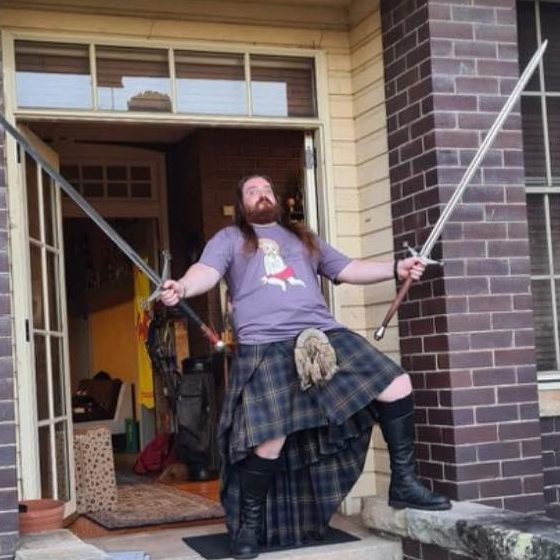
Grizzly has been with Stoccata since 2014. He has a background in sport fencing and mainly specialises in highland broadsword.
He also has a keen interest in the highland two handed sword, known as the claymore.
workshops at AWMAC
Lonnergan’s Simple Hits
This workshop will be looking at the simple hits described in Lonnergans manuals which cover basic attacks and defences to a variety of targets from head to leg. This is a beginner level class suitable for anyone.
Counterattacks with good structure and traversing
We will look at how you can counter-attack an aggressive opponent via movement and good structure before they can fully form their action and then strike them either in a single time or whilst retreating.
We will also look at how to do this whilst traversing around your opponent, allowing them to advance whilst you remove your body from the line of attack and strike.
Nathan jo

Nathan is the instructor of Sydney Korean Historic Fencing which strives to recreate the traditional Korean sword style Jedok Geom.
He also runs the Youtube channel Just a Bug and is the author of “Joseon Korean Swordsmanship from the Source – Jedok Geom”
workshops at AWMAC
Introduction to Jedok Geom – Practical Korean Swordsmanship
Jedok Geom translates to “the commander’s sword”. It is a powerful sword style designed by General Li Rusong.
In this workshop we will cover the basic stances, cuts and footwork of Jedok Geom, a Korean sword style recorded in Muyedobotongji using a long two handed single edged curved sword. Its blade length is around 100cm and a total length of 138cm.
The sword is similar to the Japanese Nodachi or the Chinese Changdao.
Bangjeokse – An Asiatic Counter to the Zornhau
The Bangjeokse is a powerful counter-cut described in the Korean manual Jedok Geom. In this workshop, we will discuss the use of this action to break the Zornhau described in Liechtenauer’s Longsword for a bit of cross-cultural problem solving.
Paul Wagner

Paul Wagner is a founding member of the Stoccata School of Defence in Sydney, Australia.
Paul specializes in British systems, with numerous publications on the subject, and is a regular instructor at international conferences.
workshops at AWMAC
ANZAC Bayonet
The bayonet is a weapon that can trace it’s origins back to the pike, and has been in continual practical use since it’s invention in the 17th century. This workshop will looks at the bayonet as taught to Australian troops during WWI, based on the manual by David Fallon, a veteran on both Gallipoli and the Western Front,
The English Way of Combat
Throughout the records of British fencing systems, there are common themes which persist throughout the tradition, from the earliest surviving sources, well into the 18th and 19th centuries. Not only is there a common theoretical basis underlying the English (or more properly “British”) tradition, but there is a long standing commonality in the approach to personal combat, including tactical choices, instructional methods and practical expression of the art, despite a variety of different weapons being used in ever-changing military and social contexts.
This workshop will explore the principles of the English way of combat, through whatever weapon you happen to favour.
peter radvan

Peter Radvan has been teaching with Stoccata School of Defence since helping to establish it in 1997.
His main interest is in English swordsmanship, and with far earlier combat systems (or styles), from periods we do not yet have any primary source material.
workshops at AWMAC
Dark Age Spear and Shield and Sword and Shield
An introduction to Dark Age Spear & Shield and Sword & Shield, extrapolated from later written sources, and secondary period sources, including Ancient Greek illustrations. You will learn how to use a one-handed spear with a large flat round center grip shield, (which will be heavier than any off hand weapon you have ever used before) for both single combat and group melees.
This will be a technically simple but highly aerobic class, though no-one will be asked to exhaust themselves.
Depending on the time available, we will also cover Sword & LR Shield, which is technically more complex, but prior experience with single sword will greatly reduce this complexity for most, if not all, students.
Richard cullinan
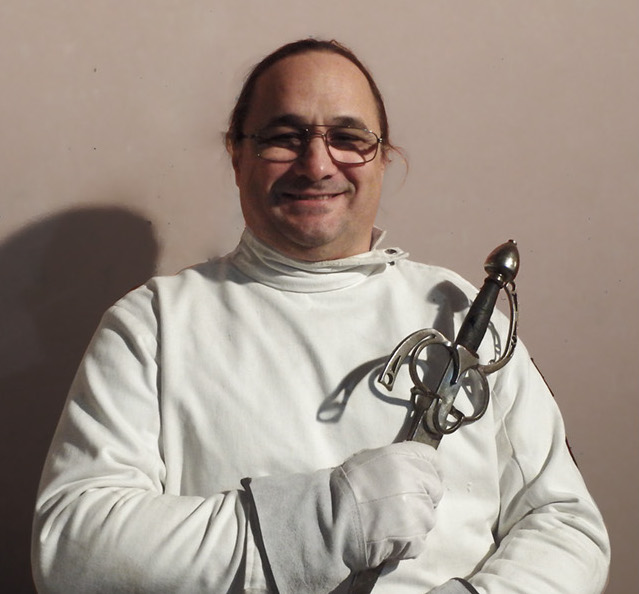
Richard is the Chief Instructor of the Stoccata Drummoyne and Rhodes branches.
Richard is recognised internationally for his research in Bolognese swordsmanship and is also qualified as an Instructor at Arms in Classical Italian fencing.
workshops at AWMAC
Bolognese Provocations
The use of provocations is the fundamental tactical strategy of Bolognese swordsmanship. This workshop will give you an appreciation of the different types of provocations, which will also help you develop an effective offensive repertoire.
Using italian fencing theory to unlock your potential
Italian fencing theory provides a basis for understanding the nature of the fencing bout, and your opponent’s reactions. We will be analysing various fencing techniques using Italian fencing theory to derive an understanding of their fundamental principles. The workshop will be initially thrust oriented in nature, moving to cut and thrust work as time permits.
scott nimmo
Scott is the founder of Melbourne Swordplay Guild.
He has taught for 21 years, focusing on Highland and British Regimental Broadsword and Armizare.
workshops at AWMAC
Motor Skill Theories and Constraint-Led Approach in HEMA & Concussion in Sport and how it relates to HEMA.
A Presentation explaining the current state of literature on Motor Skill Development, starting with an understanding of Stages and Aspects of Skill development, Decision-Making and Perceptual-Cognitive Skills, and current accepted Motor Skill Theories and how they relate to the skill acquisition approaches such as Tradition and Constraints Led. Finally, we look at the challenge of the Constraints-Led Approach in HEMA and what we can gain if we overcome these challenges.
This will be followed by a presentation on the current position on Concussion in Sport, explaining the mechanisms involved and what to look for, Australian sports recommendations, and available training and tools to anyone in HEMA. It will then finish with a discussion on the topic.
Application of Motor Skill Theory Approaches in HEMA
Constraint-led approaches have existed in sports science for twenty years but have suffered in adoption due to dense academic language; further, more sports coaching in HEMA has defaulted to traditional models of instruction, which can be seen in historical sources.
This workshop will use an introduction to Fiore’s dagger as the pretence to show examples of applying constraint-led approaches in HEMA instruction that allow the benefits while still referencing historical sources.
Stephen hand

Stephen Hand began exploring historical swordsmanship in the late 1970s, and in 1998 he became a co-founder of Stoccata.
Since 2004, Stephen has run the Stoccata branch in Hobart and continues to teach at events held around the world.
workshops at AWMAC
Two’s Company, Three’s a Melee.
How 17th century masters recommended the military sword be used in a melee.
How do I use this shield?
People are encouraged to attend with different shaped large shields and explore how their use differs from that of round “Viking style” shields.
It would be good to have ancient shields, both flat and curved such as Germanic shields, the scutum or the aspis, flat, gently and deeply curved kite and heater shields as well as any Stephen may not have worked with
In this workshop, historical combat descriptions and artwork, as well as the surviving 15th-17th century shield texts will be used to analyse how to use any large shield.
Stuart McDermid

Stu is a lifelong martial artist with experience in a number of styles of armed and unarmed fighting.
Stu’s areas of study are Longsword, rapier, sidesword, and smallsword.
Stu’s passion is for cutting edge learning theory which he uses to inform his practice design and deliver the best training he can.
workshops at AWMAC
Skills without Drills 1 – Historical Fencing via the modern tactical wheel
Using the modern Tactical wheel to build tactical skills without resorting to the now outmoded practice of static drilling.
Skills without Drills. 2
Using competitive games to improve decision making and to find creative solutions to problems in two areas:
2.1 Learning to land first intention strikes more often.
2.2 Learning to avoid double hits through competitive games.
 Stoccata School of Defence