
Wrestling and Grappling Systems
Abrazare
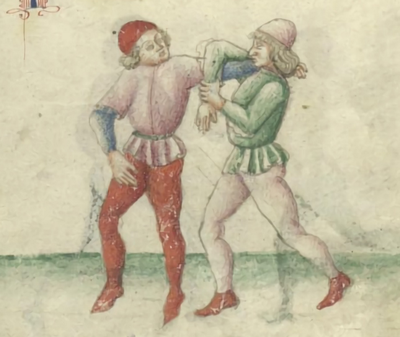
Abrazare is a Italian term used by Fiore in his manuals to describe the art of wrestling or grappling. It is integral to his fighting method for the 15th Century men at arms.
Abrazare is taught at the Rhodes branch as a part of the Italian Knightly combat program.
Thrust-oriented Weapons
Dagger

Daggers or knives were frequently worn on the belt during the medieval and Renaissance periods, and were typically used as weapons of last resort for personal defence. We have several surviving manuals describing how to defend oneself against the dagger.
Dagger is taught at our Rhodes branch as part of the Italian Knightly Combat program.
Duelling Sword

The duelling sword was the straight thrusting sword of the 19th century, descended from the European small sword or rapier. The training weapons for this sword is the forerunner of our modern foils and epees.
Duelling sword is taught at our Drummoyne branch as part of the Classical Italian Fencing program.
Rapier

The rapier as a sidearm was a symbol of wealth, fashion and nobility during the 16th and 17th Centuries. This weapon was optimised for the use of the thrust, predominately for civilian self-defence. They are generally quite ornate, with complex hilts and blades of 96 cm (38″) or more. The rapier can also be accompanied by other weapons in the offhand, such as a dagger, or a cape, or a buckler, or a rotella, or a second rapier.
Rapier fencing in the Italian tradition is taught at our Drummoyne branch . Rapier fencing in the Iberian Tradition is taught at our Baulkham Hills and Strathfield branches
Smallsword

The Smallsword was a thrusting-only weapon developed in France in the second half of the 17th century. The hilt consisted of a small shell- or disc-shaped guard much smaller than the hilt of the Renaissance rapier, and blade was relatively short and light, usually triangular or diamond-section, although double-edged flat “smallsword” blades continued to be popular well into the 18th century.
Smallsword fencing in the Scottish tradition is taught at our Asquith and Faulconbridge branches. Smallsword in the Iberian tradition is also taught at our Baulkham Hills and Strathfield branches.
Cut & Thrust Weapons
Arming Sword

Arming sword is a generic descriptor for the typical single handed sword of the medieval period. They are a straight, double-edged weapon with a single-handed, cruciform (i.e., cross-shaped) hilt and a blade length of about 70 to 80 centimetres (28 to 31 in). Knowledge on their use is restricted to a single late 13th century manuscript known as the Royal Armouries Ms. I.33 which has the distinction of being the oldest surviving fencing manual to date. This manual is for a sword and buckler fencing system, of Franconian origin.
Sword and buckler fencing in the Italian Style is taught at our Rhodes branches and in the Iberian style at our Baulkham Hills and Strathfield branches.
Basket-Hilted Shortsword, Backsword or Broadsword
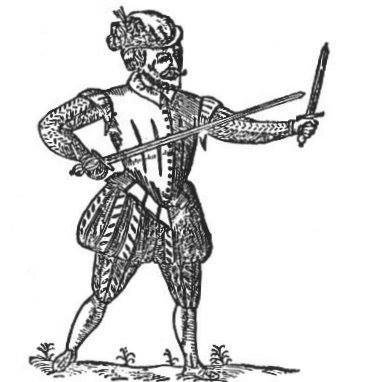
The basket-hilted sword emerged in Britain in the 16th century and came in two forms; the single-edge English backsword, and the double-edged broadsword.
We teach two systems for this weapon, that being the 16th Century English Shortsword system of George Silver (the very first system taught by the club) and the later 17th-18th Century Highland Broadsword system.
The basket-hilted sword may also be accompanied by other offhand weapons such as dagger, buckler, or shields.
English Shortsword is taught at our Faulconbridge, branch.
Highland Broadsword is taught at our Asquith and Rocks branches.
Duelling Sabre

The duelling sabre is the typical European fencing sabre of the 19th Century, and is taught using modern fencing sabres or reproduction training sabres.
Duelling sabre is taught at our Drummoyne branch as part of the Classical Italian Fencing program.
Sidesword

The sidesword is historically the transition weapon between the arming sword and the rapier, where the swords started possessing extra rings and arms to protect the sword hand. Note that sidesword is a neologism and that at the time it would have just been called sword/spada/espada/schwert. It was the main sidearm in Europe during the 16th and early 17th Century, with blade lengths of up to 96 cm (38″).
The sidesword is synonymous with Bolognese and with Iberian fencing and was routinely used with a buckler or dagger in the offhand. Other offhand weapons such a 2nd sword, rotella/rodela, cape/cloak, or shield could also be used.
Sidesword is taught at our Rhodes branch in the Scherma Bolognese program and also at our Baulkham Hills and Strathfield branches in the Iberian Tradition.
Spadroon
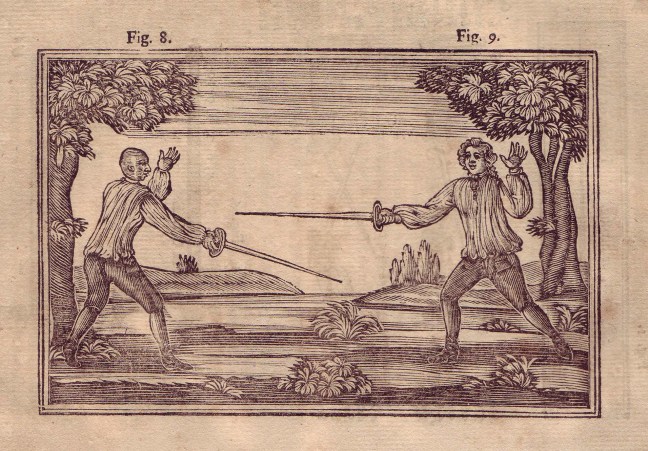
The Spadroon was a cut and thrust version of the smallsword. The hilt consisted of a small shell or disc-shaped guard much smaller than the hilt of the Renaissance rapier, and blade was relatively short and light, usually with a double-edged flat “smallsword” blades.
Spadroon fencing in the British tradition is taught at our Gunning branch.
Two Handed Weapons
Bastone

The bastone is a two handed stick, which resembles the longer walking staffs in use in Italy during the 19th Century. Fencing with the bastone was treated primarily as a gymnastic training weapon, and a weapon of opportunity on the street.
Bastone fencing in the Italian tradition is taught at our Drummoyne branch.
Longsword / Bastard Sword / Hand and a Half Sword

The European longsword was developed in response to improvements in armour design in the 14th and 15th centuries. The longsword provided more power that the single handed sword, and was able to cut, thrust, pierce or bludgeon as the situation demanded, and soon became the standard weapon of the European knight. The bastard sword or hand and a half sword is a variant of the longsword with a slightly shorter hilt.
Longsword fencing in the Liechtenauer tradition is taught at our Baulkham Hills and Strathfield branches.
Longsword fencing in the Fiore tradition is taught at our Rhodes branch.
Partisan

The partisan was the foundation polearm weapon in the Bolognese fencing tradition. Our polearm material covers partisan, speido, javelin, and ronca, and is sourced from Antonio Manciolino’s Opera Nova and Achille Marozzo’s Opera Nova.
It is also one of the most commonly used polearms during the 16th – 18th centuries, and was frequently carried by ceremonial troops.
Partisan fencing in the Italian tradition is taught at our Drummoyne branch.
Pollaxe

The pollaxe developed in the 14th – 15th century in response to increased use of plate armour amongst men at arms and knights. It became the weapon of choice for close quarters combat when fighting in and against armour.
Pollaxe fencing is taught as part of the Italian Knightly Combat program at our Drummoyne branch.
Two Handed Sword or Greatsword

The greatsword is a true two-handed sword that can trace it’s develpment to the end of the 15th Century, and is typically in excess of 5 feet (150 cm). Called Greatsword or two-handed sword by the English, claymore by the Scots, zweihander by the Germans, montante by the Spanish & Portuguese and spadone by the Italians, this weapon rightly developed a fearsome reputation on the battlefields of Europe during the 16th & 17th Centuries.
Greatsword fencing in the Italian tradition is taught at our Drummoyne branch.
 Stoccata School of Defence